Oil has been flowing out of ruptures in the Deepwater Horizon well on the ocean floor since around 10 a.m. on April 22, two days after the BP-leased rig exploded, leaving 11 workers missing and presumed dead.
According to NOAA an estimated 210,000 gallons (5,000 barrels) a day is coming from the remaining ruptures. At that rate, this leak would surpass the 11 million gallons spilled by the Exxon Valdez in 1989 in mid-June if left unchecked.
Showing posts with label environment. Show all posts
Showing posts with label environment. Show all posts
Wednesday, 2 June 2010
BP Gulf Spill-O-Meter
Nobody really knows just how much oil is being pumped out into the ocean right now from the gulf oil crisis but this little widget is a good indicator as it is calculated by estimates from the National Oceanic and Atmospheric Administration, from out side experts, from British Petroleum -- of how fast crude is flowing out of two remaining leaks (a third was plugged Wednesday).

Thursday, 13 May 2010
Fair Fuel Stabiliser - What Is It Exactly?

So, what is this new fuel pricing regime the government has come up with? Well here it is in a nutshell...
Under a Fair Fuel Stabiliser, when fuel prices go up, fuel duty would fall. And when fuel prices go down, fuel duty would rise.
This is a new way of setting fuel duty that will strengthen environmental signals when oil prices fall, and cushion the blow when fuel costs rise. Government will be sharing the pain when prices rise and sharing the gain when they fall.
If, for example, a Fair Fuel Stabiliser had been introduced at the 2008 Budget:
Fuel would be 5p per litre cheaper.
This would save up to £3.50 on each tank of fuel for a Ford Mondeo, or £2.60 for a Vauxhall Astra.
If, instead of rising, oil prices had fallen below the $84 forecast in the Budget, then fuel duty would have risen. In either case forecast government revenues would have been unchanged.
If a Fair Fuel Stabiliser had been in operation over the last year:
The average household would have saved more than £90 in fuel costs.
Instead of being 3.3%, official CPI inflation would now be below 3%.
The Proposal
Under a Fair Fuel Stabiliser, when fuel prices go up, fuel duty would fall. And when fuel prices go down, fuel duty would rise. Government would save in the good times in order to help in the bad times. It’s a classic example of fixing the roof when the sun is shining.
The Fair Fuel Stabiliser would bring three key benefits as outlined in the Conservatives manifesto:
"1. It would increase the stability of family finances. Government would be helping when the cost of living was rising sharply, by setting aside money in good times to help in difficult times.
2. It would enhance economic stability by reducing the sensitivity of the public finances and inflation to unpredictable changes in oil prices.
3. It would provide greater certainty about the price of carbon, consistent with the principles outlined in the Stern Review."
So what do you think fo the proposed Fair Fuel Stabiliser?
Conservatives New Plans For Modern Motoring

Below is a list of promises the Conservatives made as part of their "Vote For Change" campaign regarding their proposed action on fixed speed cameras...
"We will stop central funding for new fixed speed cameras and focus on better ways to make our roads safe, including authorising 'drugalyser' testing technology.
"Road users have had a raw deal under Labour, so we will:
- Crack down on rogue clampers.
- Consult on our Fair Fuel Stabiliser.
- Give more powers to local councils to get traffic moving.
- Introduce a lorry road user charge, so foreign lorries pay their fair share of tax.
- Facilitate the switch to green cars by creating a national car recharging network.
- Crack down on road works, introducing lane rental for some of our busiest roads.
"We will free local transport funding from the requirement to introduce congestion charging and create a Transport Carbon Reduction Fund to support green projects such as initiatives to encourage walking, cycling and bus use or measures to help reduce the need for work-related travel - supported by our roll-out of fast broadband..."
If all of the above points were to be introduced today the future of motoring in Britain dosen't look so bad after all, however, the implementation of such things as we all know takes so long to actually do it'll be a wonder if we see a couple of these new schemes in place within the next few years.
Of all of the above pointers, one of the more likely to be carried out sooner than later, surprisingly, is the introduction of a national car recharging network. Due to the EU commission clamping down on emissions from all major manufacturers, by 2013 we are going to see the introduction of millions of electric cars on our roads whether the government likes it or not and so a stable recharging infrastructure is going to need to be in place sooner than later to both support the citizens driving the cars and the manufacturers making them.
New Government To Introduce Car Charging Network
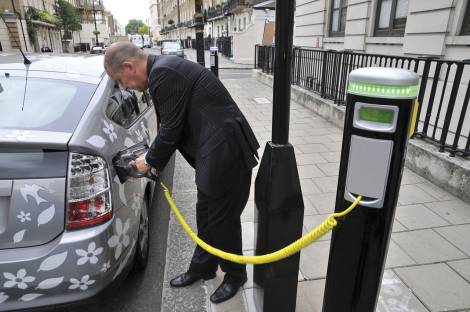
Interesting news! Our new Con-Lib government is said to have identified the importance of introducing a nation-wide network of charging points for electric and plug-in hybrid cars.
In a joint statement the Conservatives and Liberal Democrats said:
"The parties agree to implement a full programme of measures to fulfil our joint ambitions for a low carbon and eco-friendly economy, including the establishment of a smart grid and the roll-out of smart meters."
Prior to the general election last week the Conservatives promised to create a national car recharging network, while the Liberal Democrats promised a 'zero-carbon Britain.' It is now a priority of the new government.
Monday, 10 May 2010
BMW Secret Megacity Eco Car

BMW have recently released more confirming statements that they are working on an all electric, zero emissions, city car called the Megacity. The Megacity is said to be just the first in a line of many new technically innovative and efficiency orientated vehicles that BMW are planning on launching in the future.
With an estimated launch date within the next 3 years the Megacity is positioned to take on the likes of Audi's plug in electric A1 e-tron, which is with no surprise, also scheduled to launch within the same time frame of BMW's Megacity. Among other competitors from the likes of Ford and Infinity to name but a few.
Teaming with carbon-fibre specialist SGL, BMW is making use of carbon-fibre reinforced plastics for the vehicles body panels, clearly indicating a focus on light weight components which will greatly aid in the performance and agility of an electric car and especially the battery range which in early electric cars are often criticised.
At the Detroit motor show this year, BMW displayed an all electric 1 Series to demonstrate its innovation on electric drivetrains. Although it’s not certain if the final Megacity car will share any components with the 1 Series, the Bavarian manufacturer is displaying an early foothold in the soon to boom electric car market.
As part of their Project-i development program, there has been rumors that BMW might be adding another brand to their range in order to sell these new types of vehicles under. But there is no evidence of this just yet.
Dr. Norbert Reithofer, BMW's Chairman of the Board of Management said: "This vehicle will be the first of a range of near-zero emission vehicles. Customers will have the choice between a fully electric drive and a high-efficiency combustion engine. Large-scale production could start in the first half of the next decade. With the Megacity Vehicle, we are also pursuing a radical approach toward establishing a truly sustainable value chain from development to production and sales."
With many key manufacturers planning and announcing production of eco and electric cars within the next few years, it is no surprise that BMW are planning on throwing a lot of resources and investment into this compulsory future technology and by the looks of the concept picture we can expect some pretty cool cars ahead.
Friday, 7 May 2010
Ferrari Trying To Hold On To V12

As rumors of the next Ferrari Enzo heat up there is speculation and even some concern over what engine is going to make it into the final version of Ferrari's next hypercar.
The V12 has always been an iconic engine for Ferrari, for both it's performance and it's sound, and as much as the signature tone of Ferrari's flat plane V8's are music to your ears, there is nothing quite like a high revving V12. However, as the government is clamping down on all manufacturers emissions, both big and small, and eco credentials are becoming more important than ever, Ferrari are having to fall in line and reconsider the viability of putting a V12 in the next Enzo.
The boss at Ferrari, Amedeo Felisa, has hinted that the new Ferrari Enzo will be powered by a direct-injection twin-turbo V8 when it is launched in 2012.
Reports have long suggested that the new Enzo would be powered by either a V8 or a twin-turbo V6. However, Felisa has ruled out a six-cylinder engine, which i think we are all happy to hear!
“There are no plans for a six-cylinder engine,” Felisa said. “Ferrari will not build a six-cylinder engine until customer attitudes towards smaller engines change".
“The perception today is that the number of cylinders equates to the possibilities of the car. That is why we are developing hybrid technology that can be applied to our V8 and V10 cars. Hybrid means we can protect the V12.
The governmental rulings over emissions states that a portion of a companies emissions must be reduced in order to bring down the overall emissions of each car the manufacturer churns out, or else big fines are heading their way. These rules are of course important for the car giants such as Volkswagen and Fiat who are churning out millions of cars each year with a whacking great C02 contribution, however, Ferrari produce so little cars in comparison and so little miles are driven in a Ferrari compared with normal cars that these emissions policies may come across as unfair in the eyes of the niche manufacturer.
"The issue of emissions for Ferrari is more a political one than a real one. Lowering emissions of every Ferrari will not save the planet, but it will cost us a lot of money" said Felisa.
Tuesday, 4 May 2010
New All Electric VW Golf Announced

Set to go on sale in 2013 Volkswagen have announced it will be producing an all electric plug in version of the hugely popular Golf. Called the Golf Blue-e-Motion the new EV features a zero emission drive train powered by increasingly popular lithium ion batteries.
The Golf is to make up just one segment of the intended broad spectrum of electric vehicles to be added to Volkwagens range by 2013, including an electric Jetta and Lavida - focused on the chinese market.
Until multiple electric vehicle models hit Volkswagen showrooms in the future, the car giant plans to launch its electric car range with the introduction of the first Blue-e-Motion vehicle, the 'Up'. This is a car described by VW as a “city specialist” and was previewed in concept form at last year’s Frankfurt motor show.
Unveiled by German chancellor, Angela Merkel, the launch model is based on the 6th generation Golf, however, the showroom version of the Blue-e-Motion is planned to form part of the seventh generation Golf range that will begin heading into UK showrooms in the same year.
The 115bhp electric motor sits up front in the space normally occupied by the Golf’s petrol or diesel engines, develops 113bhp and 199lb ft of torque demonstrating once again the torque benefits of electric motors. This all drives the front wheels through a new single gear gearbox developed by Volkswagen called the "MQ210".
The lithium-ion battery pack mounted within the middle tunnel of the floorpan sits under the rear seat and in the floor of the boot, this makes a welcoming change to how Mini have replaced their back seats in place of the battery. The pack is said to allow for a range of 93miles and in an effort to reduce mechanical drag, it uses a separate clutch that automatically decouples its electric motor on a trailing throttle to provide what Volkswagen describes as “sailing effect”.
At 1545kg, the electric Golf weighs in as a chunky little devil at more than 305kg than the existing Golf 1.6 TDI BlueMotion. As a result Volkswagen says it hits 62mph from standstill in 11.8sec and reaches a top speed that, in the interests of retaining battery charge, is limited to 87mph. Not the most performance orientated vehicle to then but nonetheless the purpose of the new electric Golf is to make city driving more eco friendly.
Saturday, 1 May 2010
Electric Mercedes SLS AMG On It's Way

Mercedes had recently announced it's plans to produce an all electric version of it's flagship SLS AMG by 2015. However, it has just been confirmed that Mercedes are now brining forward the launch of said electric supercar to as early as 2013, 2 years earlier than planned presumably to get a better foothold in the race for the electric car market. AMG managing director Volker Mornhinweg says he has already driven the prototype cars and promises they will be as exciting as the petrol powered SLS AMG they are based on. "I can tell you that it is an amazing kind of experience" he said.
Of course, Volker being slightly biased one might expect his praises of the car, but the figures might suggest that he's right. The car is to feature 4 motors at each wheel with a combined output of 400 kilowatts equating to 536bhp, no spring chicken then! And due to the inherent nature of electric motors the available torque is staggering at 649ft/lb, thats 170ft/lb more than the existing petrol version, pretty awesome I think you will agree. As an added bonus, with their being a motor at each wheel the electric SLS will of course be all wheel drive, allowing all of that power to be put down with brilliant potency as we are seeing from the likes of the 'un-driftable' Murcielago SV.
“We can remove the combustion engine and transaxle and make no changes to the body, and we can put in two motors with the gearbox in the rear, two motors and the gearbox in the front and we can take the center console as a battery place – it looks like a T and it is perfect,” said Volker.
The car is said to have fantastic handling too because the motors are able to adjust the power going to each wheel and now the traditional coilovers have been beefed up with a pushrod actuated system that also removes the need for double wishbones found on the petrol models front suspension.
However, while all this new tech is fantastic stuff, it does carry a weight penalty, and at just over 4,600 pounds it weighs nearly a 1000 pounds more than the current SLS AMG. Ouch.
Though despite this extra weight Obias Moeres, AMG’s head of vehicle development, says it “covers its weight very easily,” Once more that is what you would expect any self respecting head of AMG development to say, but, with all that torque Moeres goes on to say it's 0-60 time is under 4 seconds and a top speed of 118mph (limited to maximise range) putting it in the same league as the Tesla Roadster, which, in comparison is a matchbox with a lego technic motor in it. so well done AMG.
Now, the setback with every electric car at the moment is the notorious battery charging time, and a good comparison to this is always the Tesla Roadster as from 'empty' to 'ready' it can take 16 hours fora full charge. I know i know it still pains me each time i write it. Despite all the above fantastic performance figures then you would expect the electric iteration of the SLS to be around the same time or even worse due to it needing extra power to pull the giant mass that it is along. But you would be wrong. Using the same lithium-ion batteries as found in all current and future production electric cars, the electric SL AMG can reach an 80% charge in... wait for it... 20 minutes! Now this has to be based on input from a Level 3 440 volt charger, but nonetheless this is incredible stuff. And by the time this thing is in showrooms in 2013 Level 3 chargers will be more accessible and probably be an optional extra with the car!
So all this leaves us to one last thing. The price. After reading back through this post the electric SLS AMG is about the first electric car that really does sound desirable and there is a reason for that, because all of that fantastic technology and performance figures is expected to cost you over a quarter of a million pounds. I think i'll leave it there for now then.
Go well.


Thursday, 29 April 2010
Ultra Eco Leaf Car - More Pictures!
Doing the rounds I came across a few more leaf car pictures earlier and thought i'd throw them up here as the original post only had the one image. These detail a little better how the unique roof of the Leaf car looks and works. Just like a real leaf, the roof is able to emit oxygen from it's surface as well as doubling as an ultra efficient solar panel which is one of the ways in which it provides power to the car as well as using the wheel turbines. Obviously this is a concept project but it actually works! Give the technology a few years and we could very well see elements of this vehicle making their way to mass produced cars in the future.


Tuesday, 20 April 2010
Format Wars - What New Fuel Will We End Up Using?

One of the most recent format wars that comes to mind is BluRay vs HD-DVD. A few years ago the tech blogs, websites and news pages were often awash with information, speculation and reviews of which format was dominating the digital entertainment industry each week. There were of course key players on both teams and if it were not for the withdrawal of Toshiba from the format race we might have been left with the choice of 2 or more formats to run your entertainment on - not that this is a bad thing. Lets face it though, most of us aren't really that fussed about what format the disc is that goes in your player, just as long as it does a good job right?
The future of fuel however is likely to be a very different story. What about our new alternative fuels? Which one will dominate? Which companies are going to get a sturdy foothold in the market share, Which fuel will you likely use and which will come to market first?
To cut this short, hybrid cars are already winning the race, which currently leaves, not the notorious oil conglomerates to mop up the money, but instead we are seeing battery manufacturers, with the likes of LGChem, laughing all the way as they struggle to keep up with the demand for ever improved lithium-ion power packs.
At this years Geneva motor show nearly every manufacturers stand featured eco inspiration in their new models and press releases, from Volkswagens super high MPG blue efficiency Polo to Ferrari's 599 HY-KERS. One particular company however, stood out the most; Porche. Typically being a manufacturer of performance orientated (and therefore uneconomical) cars, Porsche simultaneously unveiled 3 new hybrid vehicles this year, a GT3 leMans racer, the jaw dropping 918 Spyder and their all new Cayenne 4X4.
When the Carrera GT was first unveiled or even the first Cayenne just 4 years ago, the last thing on peoples minds would of been efficiency, economy or environmental responsibility. Merely a few years on and the primary focus of Porche's show as it unveiled it's latest range of super cars was it's hybrid technology and advancements in fuel and energy efficiency, demonstrating, that even companies who's last concern that seems to be only a blink ago, is now part of their flagship car, paving the way for the future and setting the benchmark for other companies to follow suit.
Hybrids, however eco friendly they are perceived today, are probably going to be an interim technology in the long run though. While the governments and super companies of the world are for ever recognising the importance of going green and eco, hybrid technology, while seemingly new, is something they have been able to turn their attention to in the short term to maximise green credentials.
The future of automotive design is looking at 100% electric vehicles and hydrogen fuel cell alternatives as well as cars that essentially power themselves from energy developed by wheel turbines and are carbon neutral as they clean the air in their immediate environment. As a personal thought, if an infrastructure (petrol stations and refineries being the primary candidates) can be developed to support hydrogen as we have done with petrol and diesel, the future of hydrogen powered cars looks healthy. There are already hydrogen fuel stations in California acting as a development program for the technology as well as serving the few hydrogen drivers currently cruising the sunny highways of LA. As we have the option of petrol and diesel today in the future it will not be unlikely to have the option of classic fuels as well as hydrogen and electric available to us at “fueling” stations.
Electric vehicles are already making a big push in the industry too. With the likes of the Silicon Valley designed Tesla Roadster making a prominent statement that performance does not have to be compromised for efficiency. With a 0-60mph time similar to that of a 911 Turbo it is a clear indicator that there is vast potential in the application of electric motors in the future of transport. Further supporting the electric trend is Volkswagen, while not focusing so much on the performance benefits electric motors bring to the table - such as 100% torque 100% of the time - Volkswagen have recently announced their Milano Taxi model which will be cleaning up the streets by 2013. Of course like all of these alternative fuels, in their infancy they each bring with them their own problems and electric cars biggest problem by far is the charging time and range. Where you might be able to drive 250 miles or so on a full charge in the Tesla, the 'empty' to 'ready' time can be 16 hours! Volkswagens Milano Taxi, albeit a lot better still only gets you an 80% charge in 4 hours - imagine standing next to the pump for that long, these are all substantial stationary charging times which the industry needs to overcome as best as it can before the masses will be able to adopt electric vehicles, even if they really want to.
In the grand scheme of things we are just scraping the surface of AF (Alternative Fuel) vehicles and their accompanying technologies, and while traditional fuel prices and gas guzzlers tax brackets are only continuing to rise, there are engines out there developing some fantastic economy figures running on traditional fuels. That being said, we are witnessing a pivotal point in automotive history that will eventually change the way the world fuels it’s transport in years to come.
New Lease Of life For Hydrogen Fuel Cells In Cars
 In recent times hydrogen has had it's fair share of stumbling block in the race to becoming an actual alternative fuel, the fear of explosions due to it's highly volatile properties, the problem with carrying large quantities of hydrogen requiring heavy tanks to be installed in vehicles and of course the lack of infrastructure to supply the fuel to the world.
However, Israeli scientists and entrepreneurs claim to have advanced hydrogen fuel one step closer to the reality of it becoming a genuine alternative fuel. As opposed to using metal or composite cylinders of compressed gas that resemble the likes of diving equipment, hydrogen is stored in thousands of miniature glass capillaries which, once development is completed, will only be slightly thicker than a human hair.
Dan Eliezer, chief scientist of Geneva based C.En Ltd said "We have shown new materials that can store more hydrogen than any other system,"
The 370 glass filaments are slotted into a larger glass tube called a capillary-array, about the width of a drinking straw. The Israeli development team say 11,000 such tubes will fuel a car for 240 miles (400km) and take less than half the space and weight of tanks currently installed in the few hydrogen cars now available.
Despite a sizeable investment of $10million into the fuel cell project by Generali Insurance, the project is unlikely to gain traction without a much larger capital injection to upscale the development. Once again with Hydrogen, one of the more significant problems is the crucial need for a substantially better infrastructure and distribution network to supply hydrogen to the masses and this will not be feasible without the support of major car companies, which have poured billions of dollars into their own closely guarded research programs.
Despite these hurdles Moshe Stern, C.En's chief executive, said "the electric car will dominate the market for years to come, but the cheap and unlimited supply of hydrogen will make it the power source of the future".
"Within a few years, perhaps a decade, hydrogen fuel will shift the world's energy balance away from oil", he said.
"The real revolution is not the technical revolution, it is the political revolution," said Stern.
"We are Israelis. We know what it means to be blackmailed by oil,"
Friday, 16 April 2010
Make Like A Car And Leaf

Following the ever growing green trend, Chinese car designer SAIC has unveiled this pretty radical looking green car type thing. I guess it looks more like a buggy actually but either way it's an interesting looking mode of transport that caught my eye. The amazing thing about this car though is not it's looks but what it actually does and how it does it.
Aptly named the 'Leaf Car' due to it's foliage inspired roof which houses photovoltaic cells, the car features individual wheel turbines, which spin a lot like those tacky 'bling' rims made ever so popular on rappers Hummers a few years ago. However, very much unlike a Hummer, SAIC claims the turbines generate electricity as the car is travelling in a sort of self charging movement. The metal-organic chassis also captures CO2 for use in a microbial fuel cell which would actually emit water vapor. In essence it runs on renewable energy and somehow emits oxygen, making it the world’s first “carbon negative” car. Put simply if this car were to make it to the road it would actually be good for the environment - cleaning the air as it went along.
Thursday, 15 April 2010
Did You Know?
I really wanted to share this with everyone, it is scary and incredible but really highlights the changing world we are in...
F1 To Go Turbo...Again?
 In May 1977 Renault revealed its first ever Formula One car, the RS/01. It boasted two distinctive innovations, one was its radial tyres developed with Michelin and the other was its engine, a 1,492cc turbo charged unit, the first of its kind in Formula 1 developing power in the 1000bhp region. This was eventually banned by the FIA in the mid eighties for a switch to naturally aspirated engines.
Today, In a bid to attract new sponsors, teams and manufacturers to the sport, Formula 1 bosses are considering a move back to smaller, 1.5 litre, turbo charged engines once again by 2013. This time it is a different story though, It is also the sports first step to help promote it's 'green' credentials along with the reintroduction of KERS that the FIA currently debating over.
If the F1 series were to drive down costs and clean up it's act by turning to the leaner greener turbo engines, Volkswagen has said it will look at entering the pinacle series in 2013 with a possible partnership with Williams and smaller engines aren't the only aspect that might be returning to the sport either, Michelin has also this week spoken about a return to F1, but has imposed several conditions on the FIA: it wants a switch to 18-inch rims to make its F1 tyres more relevant to its road and sports car programmes, and it wants the sport to be doing more for the environment.
Subscribe to:
Posts (Atom)